The Future of Edge Computing: How Fanless Box PCs Are Revolutionizing Smart Infrastructure

2026-08-28 Visits:

This two-part article explores the technological advancements, real-world applications, and future trends behind fanless box PCs in edge computing. From their seamless integration with IoT ecosystems to their scalability and reliability, we’ll uncover how these devices are reshaping industries—one compact, high-performance unit at a time.

The Rise of Fanless Box PCs – Why Efficiency Meets Innovation

1. The Evolution of Edge Computing: Why Fanless PCs Are the Next Frontier

Edge computing has long been hailed as the future of data processing, but traditional PCs—especially those with bulky cooling systems—have posed significant challenges. High power consumption, heat dissipation, and maintenance costs have limited their adoption in industrial and IoT environments.

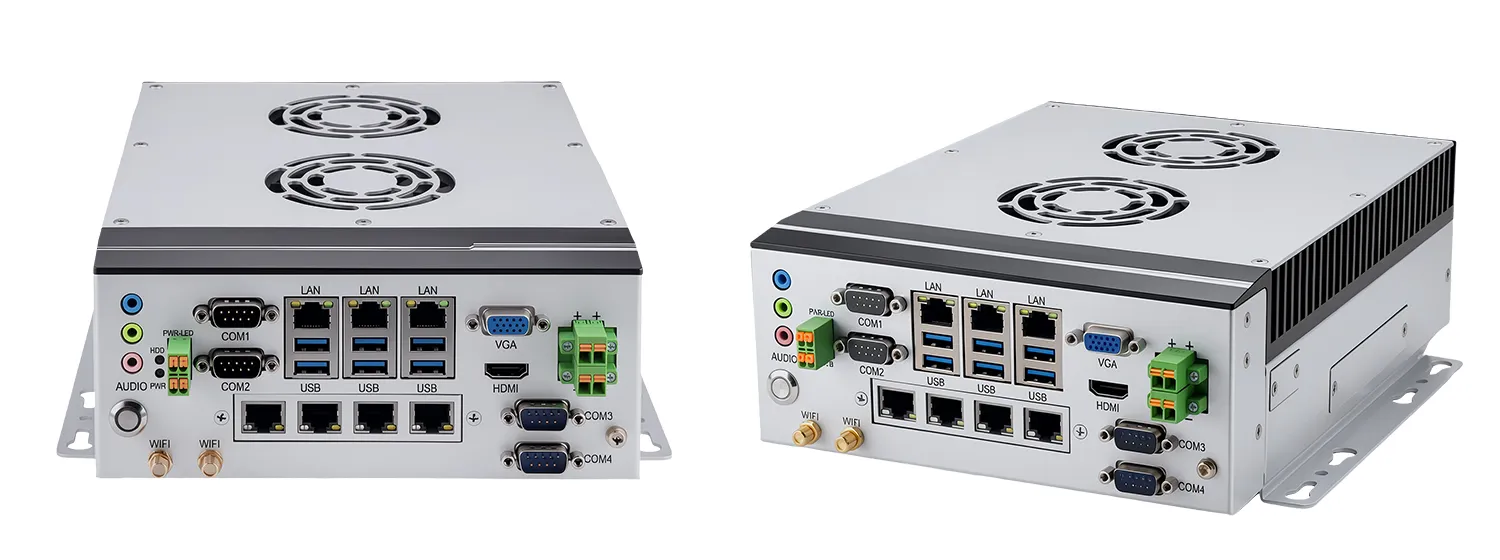
Enter fanless box PCs: a paradigm shift in computing design. Unlike conventional PCs, these devices eliminate the need for active cooling by leveraging passive heat dissipation technologies—such as heat sinks, thermal pads, and advanced thermal management materials. This not only reduces energy waste but also enhances reliability, making them perfect for 24/7 operations in harsh environments.
56744.jpg

The shift toward edge computing has accelerated due to:

Bandwidth constraints – Moving data to the cloud introduces latency, which is unacceptable for real-time applications like autonomous vehicles or industrial robotics. Regulatory demands – Governments and industries are pushing for data sovereignty, meaning sensitive information must remain within local networks. Cost efficiency – Edge devices reduce reliance on cloud infrastructure, lowering bandwidth and latency costs.

Fanless box PCs align perfectly with these demands, offering high performance without the trade-offs of traditional cooling systems.

2. Key Technologies Powering Fanless Box PCs

The success of fanless box PCs hinges on several cutting-edge technologies:

A. Advanced Heat Dissipation Solutions

Most fanless PCs use passive cooling methods:

Thermal Conductive Pads – Materials like graphene or thermal interface materials (TIMs) improve heat transfer from the CPU to the heat sink. Heat Sinks with Integrated Fans (Optional) – Some models include low-noise, high-efficiency fans that only activate under extreme conditions. Phase-Change Materials (PCMs) – These absorb and release heat dynamically, maintaining optimal temperatures.

B. High-Performance Processors Optimized for Edge Workloads

Fanless PCs often feature low-power, high-efficiency processors designed for edge computing:

Intel Core Ultra (e.g., Alder Lake-U) – Offers up to 40% better performance per watt than previous generations. AMD Ryzen V2000 Series – Known for excellent thermal management and multi-core efficiency. Qualcomm Snapdragon X Elite – Ideal for mobile edge computing (MEC) applications like AR/VR and autonomous systems.

These processors support AI acceleration, real-time processing, and low-latency applications, making fanless PCs ideal for industrial automation, smart factories, and IoT gateways.

C. Compact Form Factors for Seamless Integration

Fanless box PCs come in various form factors, including:

Mini-ITX – Perfect for embedded systems in smart cameras, drones, and industrial robots. Single-Board Computers (SBCs) – Used in IoT edge nodes for lightweight applications. Rack-Mountable Units – Ideal for data centers and enterprise networks.

Their small size and modular design allow easy deployment in narrow spaces, reducing installation costs.

3. Real-World Applications Where Fanless Box PCs Excel

The versatility of fanless box PCs makes them indispensable across industries:

A. Industrial Automation & Smart Factories

In smart factories, real-time data processing is critical for predictive maintenance, quality control, and automation. Fanless PCs:

Process sensor data without latency. Run AI-driven analytics for predictive maintenance. Enable robotics with low-power, high-speed computing.

B. IoT & Smart City Deployments

From smart traffic lights to waste management systems, fanless PCs power:

Edge gateways for 5G and wireless networks. Weather stations and environmental monitoring. Smart parking systems with real-time analytics.

C. Autonomous Vehicles & Drones

In self-driving cars and drones, fanless PCs provide:

Low-latency processing for real-time decision-making. Energy efficiency for extended flight times. Reliability in extreme weather conditions.

D. Healthcare & Telemedicine

Fanless PCs enable remote patient monitoring by:

Processing medical imaging locally. Supporting AI diagnostics without cloud dependency. Ensuring secure data transmission in HIPAA-compliant environments.

4. The Future of Fanless Box PCs: Trends to Watch

As edge computing continues to evolve, fanless PCs will play an even bigger role:

AI & Machine Learning Integration – Future models will include dedicated AI accelerators for real-time inference. 5G & Edge Computing Synergy – Fanless PCs will become critical nodes in 5G networks, handling massive data flows. Sustainability & Green Computing – With lower energy consumption, these devices align with ESG (Environmental, Social, Governance) goals. AIoT (Artificial Intelligence + IoT) Expansion – Fanless PCs will drive smart cities, autonomous infrastructure, and next-gen robotics.

Performance Optimization & Cost-Effective Edge Computing with Fanless Box PCs


Leave Your Message


Leave a message

We use cookie to improve your online experience. By continuing to browse this website, you agree to our use of cookie.

Cookies

Please read our Terms and Conditions and this Policy before accessing or using our Services. If you cannot agree with this Policy or the Terms and Conditions, please do not access or use our Services. If you are located in a jurisdiction outside the European Economic Area, by using our Services, you accept the Terms and Conditions and accept our privacy practices described in this Policy.
We may modify this Policy at any time, without prior notice, and changes may apply to any Personal Information we already hold about you, as well as any new Personal Information collected after the Policy is modified. If we make changes, we will notify you by revising the date at the top of this Policy. We will provide you with advanced notice if we make any material changes to how we collect, use or disclose your Personal Information that impact your rights under this Policy. If you are located in a jurisdiction other than the European Economic Area, the United Kingdom or Switzerland (collectively “European Countries”), your continued access or use of our Services after receiving the notice of changes, constitutes your acknowledgement that you accept the updated Policy. In addition, we may provide you with real time disclosures or additional information about the Personal Information handling practices of specific parts of our Services. Such notices may supplement this Policy or provide you with additional choices about how we process your Personal Information.


Cookies

Cookies are small text files stored on your device when you access most Websites on the internet or open certain emails. Among other things, Cookies allow a Website to recognize your device and remember if you've been to the Website before. Examples of information collected by Cookies include your browser type and the address of the Website from which you arrived at our Website as well as IP address and clickstream behavior (that is the pages you view and the links you click).We use the term cookie to refer to Cookies and technologies that perform a similar function to Cookies (e.g., tags, pixels, web beacons, etc.). Cookies can be read by the originating Website on each subsequent visit and by any other Website that recognizes the cookie. The Website uses Cookies in order to make the Website easier to use, to support a better user experience, including the provision of information and functionality to you, as well as to provide us with information about how the Website is used so that we can make sure it is as up to date, relevant, and error free as we can. Cookies on the Website We use Cookies to personalize your experience when you visit the Site, uniquely identify your computer for security purposes, and enable us and our third-party service providers to serve ads on our behalf across the internet.

We classify Cookies in the following categories:
 ●  Strictly Necessary Cookies
 ●  Performance Cookies
 ●  Functional Cookies
 ●  Targeting Cookies


Cookie List
A cookie is a small piece of data (text file) that a website – when visited by a user – asks your browser to store on your device in order to remember information about you, such as your language preference or login information. Those cookies are set by us and called first-party cookies. We also use third-party cookies – which are cookies from a domain different than the domain of the website you are visiting – for our advertising and marketing efforts. More specifically, we use cookies and other tracking technologies for the following purposes:

Strictly Necessary Cookies
These cookies are necessary for the website to function and cannot be switched off in our systems. They are usually only set in response to actions made by you which amount to a request for services, such as setting your privacy preferences, logging in or filling in forms. You can set your browser to block or alert you about these cookies, but some parts of the site will not then work. These cookies do not store any personally identifiable information.

Functional Cookies
These cookies enable the website to provide enhanced functionality and personalisation. They may be set by us or by third party providers whose services we have added to our pages. If you do not allow these cookies then some or all of these services may not function properly.

Performance Cookies
These cookies allow us to count visits and traffic sources so we can measure and improve the performance of our site. They help us to know which pages are the most and least popular and see how visitors move around the site. All information these cookies collect is aggregated and therefore anonymous. If you do not allow these cookies we will not know when you have visited our site, and will not be able to monitor its performance.

Targeting Cookies
These cookies may be set through our site by our advertising partners. They may be used by those companies to build a profile of your interests and show you relevant adverts on other sites. They do not store directly personal information, but are based on uniquely identifying your browser and internet device. If you do not allow these cookies, you will experience less targeted advertising.

How To Turn Off Cookies
You can choose to restrict or block Cookies through your browser settings at any time. Please note that certain Cookies may be set as soon as you visit the Website, but you can remove them using your browser settings. However, please be aware that restricting or blocking Cookies set on the Website may impact the functionality or performance of the Website or prevent you from using certain services provided through the Website. It will also affect our ability to update the Website to cater for user preferences and improve performance. Cookies within Mobile Applications

We only use Strictly Necessary Cookies on our mobile applications. These Cookies are critical to the functionality of our applications, so if you block or delete these Cookies you may not be able to use the application. These Cookies are not shared with any other application on your mobile device. We never use the Cookies from the mobile application to store personal information about you.

If you have questions or concerns regarding any information in this Privacy Policy, please contact us by email at . You can also contact us via our customer service at our Site.